
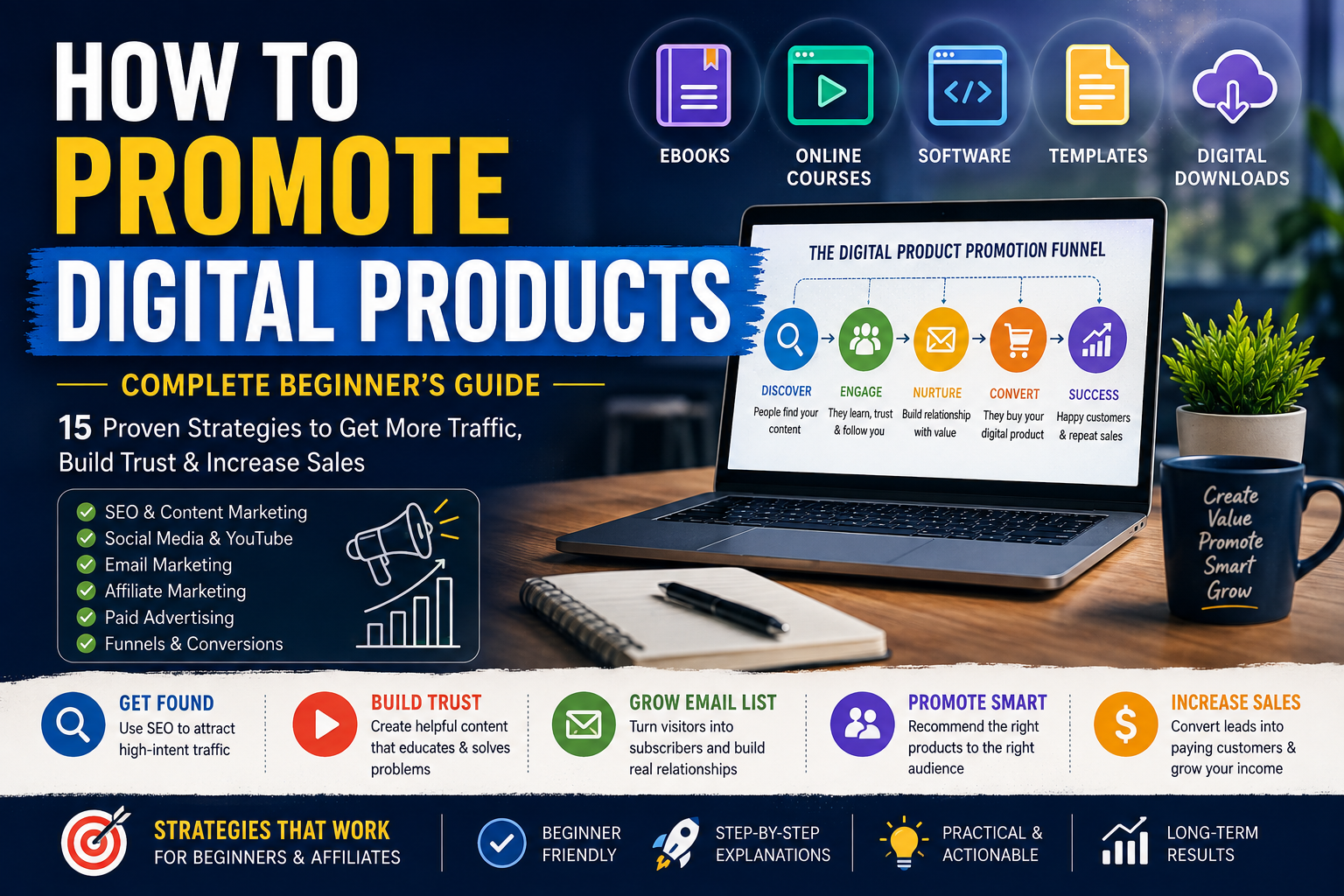
How to Promote Digital Products: A Complete Beginner’s Guide
Disclosure: This article may contain affiliate links. If you purchase a product or service through one of the links on this page, I may earn a commission at no additional cost to you. This does not affect my editorial opinion, and I only recommend products and strategies that I believe can provide genuine value.
Creating a digital product is only half the job.
The other half is getting the right people to discover it, understand its value, trust the person recommending or selling it, and eventually make a purchase.
That is where digital product promotion becomes important.
Whether you’re promoting an ebook, online course, software, template, membership, AI tool, marketing system, design resource, digital guide, or another type of downloadable product, simply putting a sales page online rarely creates consistent sales.
You need a system.
That system can include SEO, content marketing, email marketing, social media, YouTube, Pinterest, affiliate marketing, online communities, partnerships, paid advertising, comparison articles, product reviews, and conversion optimization.
But there’s an important mistake beginners often make.
They try to use everything at once.
They create a Facebook page, start a YouTube channel, publish blog posts, run ads, create Pinterest pins, send emails, post on Instagram, join groups, and promote ten different products — all at the same time.
The result is usually a lot of activity but very little measurable progress.
A better approach is to understand how digital product promotion actually works, choose the channels that match your audience, and build a repeatable process.
This guide explains how to promote digital products from the ground up, including free traffic strategies, paid promotion, affiliate marketing, SEO, email marketing, social media, funnels, product reviews, and the mistakes you should avoid.
Quick Answer: What Is the Best Way to Promote Digital Products?
There isn’t one universal promotion method that works for every digital product.
The best strategy depends on:
- What you’re selling
- Who you’re selling it to
- Where your audience spends time
- Your marketing budget
- Your existing audience
- Your skills
- Your conversion funnel
- How much time you can invest
For a beginner with a limited budget, I would generally start with SEO/content marketing, social content, email list building, and carefully selected affiliate or partnership opportunities before spending heavily on advertising.
For a creator who already has an audience, email marketing and content promotion may be more efficient.
For a software company or high-value digital product, SEO, comparison content, demonstrations, webinars, YouTube, partnerships, and paid search can all make sense.
For an affiliate marketer, helpful reviews, comparisons, tutorials, SEO content, email, and targeted social content can work together to move someone from research to purchase.
The important thing is not to ask:
“Where can I post my link?”
Ask:
“Where are people who have this problem already looking for a solution?”
That change in thinking can completely improve your promotion strategy.
What Are Digital Products?
Digital products are products that can be created, sold, and delivered electronically rather than physically shipped.
Examples include:
- Ebooks
- Online courses
- Software
- SaaS subscriptions
- AI tools
- Templates
- Spreadsheets
- Design assets
- Printables
- Presets
- Digital planners
- Memberships
- Paid communities
- Plugins
- Website themes
- Audio products
- Video training
- Marketing resources
- Business guides
- Digital services packaged as products
For affiliate marketers, digital products can also include software and online services that pay commissions when referred customers purchase.
One reason digital products are attractive to online businesses is that distribution doesn’t require conventional physical inventory or shipping. However, that doesn’t mean they’re automatically easy to sell.
The customer still has to discover the product, understand the offer, trust it, and decide that the purchase is worthwhile.
That is why marketing is part of the product business, not something you do only after creating the product.
Why Is Promoting Digital Products Difficult?
A digital product can be excellent and still fail to generate sales.
Why?
Because quality and visibility are two different things.
Imagine you create a fantastic $29 ebook about starting a small online business.
The information is useful.
The design looks professional.
The checkout works.
The product solves a real problem.
But only 20 people know it exists.
You don’t have a marketing problem because the product is bad.
You have a distribution problem.
Now imagine another product that is average but is promoted constantly to a large, relevant audience.
It may generate more sales simply because more potential customers see it.
This is why digital product promotion requires three things:
1. Visibility
People need to discover you or the product.
2. Trust
People need a reason to believe the product can solve their problem.
3. Conversion
People need a clear and convenient path to purchase.
A strong promotion strategy addresses all three.
Step 1: Understand Your Digital Product Before Promoting It
Before thinking about Instagram, SEO, Pinterest, Google Ads, or email, understand exactly what you’re promoting.
You should be able to answer these questions in simple language:
- What is the product?
- Who is it for?
- What problem does it solve?
- What does the buyer receive?
- How does it work?
- What makes it different?
- What does it cost?
- What are its limitations?
- What experience does the buyer need?
- What alternatives exist?
- Why should someone choose it?
If you can’t explain the product clearly, promotion becomes difficult.
For example, saying:
“This software has AI-powered automation, advanced integrations, dynamic workflows, and multiple productivity features.”
isn’t particularly useful.
A better explanation would be:
“This tool helps small businesses automate repetitive customer follow-ups without manually sending every message.”
The second statement immediately explains the problem and the benefit.
Promote the problem, not just the product
One of the most useful principles in digital marketing is to start with the customer’s problem.
People don’t normally wake up thinking:
“I need another digital product.”
They think:
- “I need more traffic.”
- “I don’t know how to build a website.”
- “I need better social media content.”
- “I want to learn SEO.”
- “I need a faster way to edit videos.”
- “I need a template.”
- “I want to learn a new skill.”
- “I need software to automate this task.”
Your promotional content should connect the product with that existing need.
Step 2: Choose a Specific Target Audience
One of the biggest mistakes in digital product marketing is trying to sell to everyone.
Suppose you’re promoting an SEO course.
“Anyone interested in SEO” is a very broad audience.
You could narrow it to:
- SEO beginners
- Bloggers
- Affiliate marketers
- Local businesses
- Ecommerce store owners
- SaaS companies
- Freelancers
- Agencies
You can narrow it further.
For example:
“SEO for affiliate websites with less than 100 pages.”
Now you have a much clearer audience.
This makes your:
- Keywords
- Headlines
- Videos
- Emails
- Social posts
- Reviews
- Examples
- Calls to action
much easier to create.
A useful audience framework
Write down:
Audience: Who are they?
Problem: What are they struggling with?
Desired outcome: What do they want?
Current solution: What are they doing now?
Obstacle: Why isn’t it working?
Product: How does your product help?
This simple framework can become the foundation of your entire marketing campaign.
Step 3: Create a Strong Value Proposition
Your value proposition is the simple reason someone should care.
It should answer:
“Why should I pay attention to this?”
A weak value proposition focuses on features.
A stronger one connects features with outcomes.
For example:
Weak:
“Includes 50 editable templates.”
Better:
“Create professional social media posts faster using 50 ready-to-edit templates.”
The second version explains why the feature matters.
This becomes especially important when you’re promoting someone else’s digital product as an affiliate.
You shouldn’t simply repeat the vendor’s sales copy.
Instead, explain:
- What the product does
- Who benefits
- What problem it addresses
- What you like
- What limitations exist
- What alternatives are available
That creates useful content rather than another advertisement.
Step 4: Build a Central Destination for Your Traffic
Before sending traffic everywhere, decide where you want visitors to go.
This could be:
- Your product page
- Your website
- A detailed review
- A comparison article
- A landing page
- A lead magnet
- An email opt-in page
- A product demonstration
- A YouTube video
For an affiliate website like NikhilPatelReview.com, a strong approach is often:
Search query → Helpful article → Product explanation → Comparison → Affiliate CTA
For example:
“Best AI tools for marketers”
↓
Helpful comparison article
↓
Individual product review
↓
Pros and cons
↓
Alternative comparison
↓
Affiliate link
This is much more useful than publishing a page that says:
“Buy this product.”
Step 5: Use SEO to Build Long-Term Organic Traffic
SEO can be one of the most useful promotion channels for digital products because people already use search engines to find solutions.
Search traffic can come from queries such as:
- Best email marketing software
- Best AI tools for bloggers
- How to build a sales funnel
- Best affiliate marketing tools
- How to create digital products
- Best tools for YouTube creators
- ClickFunnels alternatives
- Best software for small businesses
Search-focused content allows you to meet people when they are already researching a problem.
Current digital-product marketing guidance continues to emphasize SEO, educational content, product pages, and useful blog content as organic acquisition methods.
Step 6: Write Product Reviews That Actually Help Buyers
Product reviews are especially valuable for affiliate websites.
But a review should not simply rewrite the sales page.
A strong affiliate review answers questions a potential buyer is already asking.
For example:
What is the product?
Explain it simply.
Who is it for?
Tell readers whether beginners or experienced users are more likely to benefit.
What does it do?
Explain the actual use case.
What are the advantages?
Be specific.
What are the limitations?
Be honest.
What does it cost?
Verify the current price.
What are the alternatives?
Give readers other options.
Is it worth it?
Explain the circumstances rather than giving an automatic yes.
This is the style we used for your FE Unleashed Sales Machine review.
That type of article can naturally link back to this broader guide using anchor text such as:
how to promote digital products
This creates a useful content relationship rather than an artificial SEO link.
Step 7: Use Comparison Articles
Comparison content is powerful because people searching for comparisons are often already considering a purchase.
Examples:
- Product A vs Product B
- Best alternatives to Product A
- Product A alternatives
- Best tools for affiliate marketers
- Best email marketing platforms
- Best funnel builders
- Best AI writing tools
- Best website builders
A comparison article should not simply declare a winner.
Instead, explain:
| Buying Factor | Product A | Product B |
|---|---|---|
| Best for | Beginners | Advanced users |
| Pricing | Verify current price | Verify current price |
| Ease of use | Simple | More advanced |
| Features | Core features | Broader features |
| Customization | Moderate | Extensive |
| Best use case | Small projects | Larger businesses |
The reader should be able to decide based on their own needs.
That makes the article more trustworthy.
Step 8: Use Content Marketing
Content marketing is one of the safest long-term ways to promote digital products because you can educate people before asking them to buy.
Your content can include:
- Blog posts
- Tutorials
- Guides
- Case studies
- Videos
- Checklists
- Infographics
- FAQs
- Comparisons
- Product reviews
- How-to articles
Salesforce similarly recommends educational content such as blog posts, videos, and case studies as ways to build credibility while promoting digital products.
The 80/20 idea
You don’t necessarily need to follow a rigid 80/20 rule, but the principle is useful:
Most of your content should help the audience.
Promotion should be part of the content ecosystem rather than the only reason the content exists.
For example:
Instead of:
“Buy this SEO tool.”
Create:
“How to Find Low-Competition Keywords for a New Website”
Then demonstrate how a relevant tool can help.
The product becomes part of the solution.
Step 9: Promote Digital Products Through Email Marketing
Email is one of the most valuable channels because you aren’t completely dependent on social algorithms.
The basic process is:
Free content
↓
Lead magnet
↓
Email subscriber
↓
Helpful emails
↓
Relevant recommendation
↓
Purchase
Your lead magnet could be:
- Checklist
- PDF guide
- Mini-course
- Template
- Spreadsheet
- Keyword list
- Content calendar
- Tutorial
- Free resource
The important thing is relevance.
If your website is about affiliate marketing, don’t offer a random free recipe ebook simply because it’s easy to create.
Offer something related to what your visitors actually came to learn. FE Unleashed Sales Machine
How to Build a Simple Email Funnel
A beginner-friendly email sequence could look like this:
Email 1: Deliver the free resource
Give subscribers what they requested.
Email 2: Teach something useful
Solve a small problem.
Email 3: Discuss a common mistake
Show readers what often goes wrong.
Email 4: Introduce a solution
Explain a tool or product that addresses the problem.
Email 5: Comparison
Explain who should and shouldn’t use the product.
Email 6: Practical tutorial
Show how the product or strategy can be implemented.
Email 7: Recommendation
Give the reader a clear next step.
The goal isn’t to send seven advertisements.
The goal is to build understanding and trust.
Step 10: Promote Digital Products on Social Media
Social media can create awareness quickly, but simply dropping affiliate links into posts is rarely a strong strategy.
Instead, use social media to distribute useful content.
You can create:
- Short tutorials
- Tips
- Mistakes to avoid
- Before/after demonstrations
- Product walkthroughs
- Comparisons
- FAQs
- Short reviews
- Myth-busting posts
- Checklists
- Educational carousels
A useful content structure is:
Problem → Insight → Solution → CTA
Example:
“Getting traffic but no affiliate sales?”
Then explain three reasons this can happen.
Finally:
“I covered the complete funnel process in my full guide.”
The social post creates interest.
The website article provides depth.
The affiliate recommendation becomes part of the solution.
Step 11: Use YouTube for Demonstration-Based Promotion
YouTube is particularly useful for digital products because video allows you to demonstrate how something works.
For software, this is especially powerful.
Possible video formats include:
Tutorial
How to Build an Affiliate Funnel
Review
Product X Review: Features, Pricing and Pros & Cons
Comparison
Product X vs Product Y
Walkthrough
How Product X Works
Problem-solving video
How to Automate Your Email Follow-Up
The video should provide useful information even if the viewer doesn’t buy.
That builds credibility.
Step 12: Use Pinterest for Searchable Visual Content
Pinterest can be useful for certain digital-product categories, particularly visually oriented products such as:
- Templates
- Printables
- Planners
- Design resources
- Blogging resources
- Business guides
- Marketing checklists
- Recipes
- Educational downloads
It can also be used to distribute blog content.
For your affiliate website, you could create pins for articles such as:
How to Promote Digital Products
Best Affiliate Marketing Tools
FE Unleashed Sales Machine Review
Best Funnel Builders for Beginners
The important point is to create a useful visual headline rather than turning every pin into a hard sales advertisement.
Step 13: Promote Through Affiliate Marketing
Affiliate marketing is particularly relevant to digital products.
The basic model is:
Product owner
↓
Affiliate
↓
Audience
↓
Tracked referral
↓
Sale
↓
Commission
For an affiliate marketer, this means you don’t necessarily need to create the product yourself.
You can promote products that are relevant to your audience.
Examples include:
- Software
- Courses
- Hosting
- Marketing tools
- AI platforms
- Website tools
- Business resources
- Productivity software
But choosing products carefully matters.
Don’t promote a product simply because the commission is high.
Ask:
- Does my audience need it?
- Is the product relevant?
- Is the sales page clear?
- Is the pricing reasonable?
- Are there good alternatives?
- Can I explain the product honestly?
- Can I disclose the affiliate relationship?
- Would I be comfortable recommending it?
Trust is more valuable than one commission.
Step 14: Create a Product Review Funnel
A very effective affiliate content structure is:
Informational article
↓
Product review
↓
Comparison
↓
Affiliate recommendation
For example:
Article 1
How to Promote Digital Products
↓
links to
Article 2
Best Affiliate Marketing Tools for Beginners
↓
links to
Article 3
FE Unleashed Sales Machine Review
↓
links to
Article 4
FE Unleashed vs Other Funnel Solutions
This creates a content ecosystem.
Someone can enter your site through an informational search and gradually discover relevant products.
That’s much more natural than trying to sell immediately.
Step 15: Use Free Traffic Strategies
If you’re starting with a small budget, you don’t need to begin with paid advertising.
You can build traffic through:
- SEO
- Blog content
- YouTube
- Social media
- Online communities
- Partnerships
- Guest contributions
- Helpful answers
- Referral traffic
The downside is time.
Free traffic isn’t truly free.
You pay with:
- Time
- Research
- Content creation
- Learning
- Consistency
But you don’t necessarily need a large advertising budget.
A recent 2026 guide on low-budget digital-product promotion similarly emphasizes content, search, email, partnerships, communities, and consistent promotion as ways creators can build visibility without relying entirely on paid ads.
Step 16: Use Online Communities Carefully
Communities can produce excellent targeted traffic when you genuinely contribute.
Examples include:
- Facebook Groups
- Niche forums
- Discord communities
- Professional communities
- Industry groups
But don’t join a community today and immediately post:
“Buy my product!”
That is promotional behavior, not community participation.
Instead:
- Read the rules.
- Understand the community.
- Answer questions.
- Share useful information.
- Participate consistently.
- Link to your content only where appropriate.
Some communities prohibit affiliate links entirely.
Always follow their rules.
Step 17: Use Paid Advertising Carefully
Paid advertising can accelerate traffic, but it can also accelerate losses.
That’s why I would not recommend that beginners immediately spend large amounts on ads.
Before buying traffic, understand:
- Your product conversion rate
- Your average order value
- Your commission
- Your customer acquisition cost
- Your landing-page conversion rate
- Your refund rate
- Your tracking system
Suppose you’re earning $30 per sale.
If it costs $50 to generate each sale, you have a problem.
If it costs $10, the campaign may have room to scale.
The numbers matter.
Salesforce also identifies search ads, social advertising, display advertising, and retargeting as possible digital-product promotion channels.
Step 18: Don’t Start Paid Advertising Before Your Funnel Is Ready
Before sending paid traffic, make sure:
- Your landing page works.
- Your links work.
- Your tracking works.
- Your offer is understandable.
- Your checkout works.
- Your audience is clearly defined.
- Your ad matches the landing page.
- Your economics make sense.
Otherwise you’re paying for people to discover problems in your funnel.
That’s an expensive way to test a website.
Step 19: Use Retargeting When Appropriate
Some visitors won’t purchase the first time.
That’s normal.
Someone might:
- Read your article
- Visit the product page
- Compare alternatives
- Leave
- Come back later
Retargeting can help bring some visitors back.
However, retargeting involves advertising platforms, tracking technology, privacy requirements, and changing platform policies.
Make sure your implementation follows the applicable laws, platform rules, consent requirements, and privacy policies.
Step 20: Use Free Tools and Samples
One of the easiest ways to demonstrate the value of a digital product is to give people something useful before asking them to purchase.
For example:
If you sell a course about SEO:
Free: SEO checklist
Paid: Complete SEO course
If you sell templates:
Free: 5 templates
Paid: 100-template bundle
If you sell software:
Free: Trial or limited version
Paid: Full functionality
The free resource should make the paid product easier to understand.
It shouldn’t simply be a random giveaway.
Best Digital Product Promotion Strategy for Beginners
If you’re starting today and don’t have a large audience, here’s the approach I’d recommend:
1. Choose one niche
Don’t promote everything.
2. Choose a small number of relevant products
Quality over quantity.
3. Build a website or content hub
Give your traffic somewhere useful to go.
4. Create one pillar article
Make it comprehensive.
5. Publish supporting articles
Build topical depth.
6. Create detailed product reviews
Answer buying questions.
7. Create comparison articles
Help visitors evaluate options.
8. Start collecting email subscribers
Build an audience you can communicate with directly.
9. Repurpose your articles
Turn them into videos, social posts, and pins.
10. Measure everything
Improve based on evidence.
This approach may feel slower than buying a “secret traffic system.”
But it’s much easier to understand, maintain, and improve.
Frequently Asked Questions
What is the best way to promote digital products?
There is no single best channel for every product. SEO, content marketing, email, social media, YouTube, partnerships, affiliate marketing, and paid advertising can all be useful depending on the audience and product.
For beginners with limited budgets, starting with useful content, SEO, email list building, and organic social distribution can be a practical approach.
How can I promote digital products for free?
You can use SEO, blog content, YouTube, Pinterest, organic social media, email marketing, communities, partnerships, and other organic channels.
These methods don’t require the same upfront advertising budget as paid campaigns, but they do require time and consistent effort.
Can I promote digital products without an audience?
Yes, but you still need to reach people somehow.
You can build an audience through search traffic, YouTube, social platforms, Pinterest, communities, partnerships, and email list building.
The goal isn’t necessarily to have a huge audience. A smaller, relevant audience can be valuable.
How do I promote digital products on social media?
Create useful content around the problem your product solves.
Tutorials, comparisons, tips, demonstrations, FAQs, short videos, and educational posts can work better than repeatedly posting direct sales messages.
Is SEO good for digital products?
SEO can be a useful long-term traffic channel when people actively search for information related to the product or problem.
Useful content, relevant keywords, good site structure, internal linking, and clear product information can all contribute to an organic search strategy.
Should I use paid ads to promote digital products?
Paid advertising can work, but it should be approached carefully.
Before spending significant money, understand your conversion rate, customer acquisition cost, commission or profit margin, and tracking.
Start with controlled tests rather than assuming advertising will automatically produce profitable sales.
Can affiliate marketing be used to promote digital products?
Yes.
Affiliate marketing allows creators, publishers, influencers, and other partners to earn commissions for referring customers when an appropriate affiliate program is available.
For an affiliate website, reviews, tutorials, comparisons, and buyer guides can all be useful promotion formats.
How do I promote software products?
Software can benefit from demonstrations, tutorials, reviews, comparisons, pricing guides, alternative articles, YouTube videos, SEO content, email marketing, and affiliate partnerships.
Showing how the software solves a real problem can be more useful than simply listing features.
How do I promote an online course?
Explain who the course is for, what it teaches, the format, curriculum, support, price, limitations, and alternatives.
Free educational content can help potential buyers understand your expertise before they decide whether to purchase.
How often should I promote a digital product?
There is no universal number.
You can mention a product whenever it is genuinely relevant to the content.
Avoid turning every piece of content into the same advertisement.
Should I promote multiple digital products?
You can, but relevance matters.
For an affiliate website, it is often better to develop authority around a particular category and promote a carefully selected group of relevant products rather than promoting everything available.
How long does digital product marketing take?
It depends on the product, audience, traffic source, competition, and execution.
Some channels can generate traffic quickly, while SEO and audience building can require much longer-term consistency.
There is no honest universal timeline for guaranteed results.
What should I track when promoting digital products?
Useful metrics include:
- Website traffic
- Click-through rate
- Email opt-ins
- Product-page visits
- Conversion rate
- Revenue
- Affiliate clicks
- Commission
- Customer acquisition cost for paid campaigns
- Return on ad spend where applicable
Tracking helps you identify where the funnel needs improvement.
Final Verdict: How to Promote Digital Products Successfully
Promoting digital products isn’t about finding one secret traffic source.
It’s about creating a system that repeatedly connects the right audience with the right solution.
For most beginners, I would start with a simple structure:
Choose a specific audience
↓
Understand their problem
↓
Choose relevant products
↓
Create genuinely useful content
↓
Build SEO and organic traffic
↓
Use social/video/Pinterest where appropriate
↓
Build an email list
↓
Create reviews and comparisons
↓
Use affiliate partnerships
↓
Test paid advertising only when the numbers make sense
↓
Measure and improve
The biggest mistake is thinking that promotion means putting a purchase link everywhere.
It doesn’t.
Good promotion is about helping the right person make a better decision.
That approach is particularly important for an affiliate review website.
When someone visits NikhilPatelReview.com, they shouldn’t feel like they’re being pushed toward the highest commission.
They should feel that they can find:
- Honest product explanations
- Useful tutorials
- Clear comparisons
- Pros and cons
- Current pricing information
- Alternatives
- Practical marketing advice
If you consistently build that kind of resource, your product reviews and affiliate recommendations become a natural part of the website rather than the entire purpose of every page.
And that’s the foundation I would use for promoting digital products sustainably.